

As a supplier of Bronze Frosted Glass, I often encounter inquiries about the technical aspects of our products. One of the most frequently asked questions is about the refractive index of Bronze Frosted Glass. In this blog post, I'll delve into what the refractive index is, how it relates to Bronze Frosted Glass, and why it matters for your projects.
Understanding the Refractive Index
The refractive index is a fundamental property of any transparent or translucent material. It is defined as the ratio of the speed of light in a vacuum to the speed of light in the material. Mathematically, it is expressed as (n = \frac{c}{v}), where (n) is the refractive index, (c) is the speed of light in a vacuum ((c\approx 299,792,458\ m/s)), and (v) is the speed of light in the material.
When light passes from one medium to another with a different refractive index, it changes direction. This phenomenon is known as refraction. The refractive index determines how much the light will bend. A higher refractive index means that light will travel more slowly through the material and bend more when entering or exiting the material.
Refractive Index of Glass in General
The refractive index of glass can vary depending on its composition. For common soda - lime glass, which is widely used in windows and containers, the refractive index typically ranges from about 1.51 to 1.52. Borosilicate glass, known for its high thermal resistance, has a refractive index around 1.47. These values are for clear, non - frosted glass.
Factors Affecting the Refractive Index of Bronze Frosted Glass
Bronze Frosted Glass is a specialized type of glass. The frosting process, which can be achieved through methods such as Frosted Etched Glass or Sandblasted Frosted Glass, and the addition of bronze colorants, can influence its refractive index.
Frosting Process
The frosting of glass creates a rough surface on the glass. This rough surface scatters light in multiple directions, which is why frosted glass appears opaque or semi - opaque. The scattering of light can make it more difficult to measure the refractive index in the traditional sense. However, the underlying glass material still has a refractive index that is affected by the base glass composition.
The frosting process does not significantly change the refractive index of the bulk glass material. The refractive index of the glass matrix remains similar to that of the non - frosted glass of the same composition. But the surface roughness can cause local variations in the path of light, leading to a more complex interaction between light and the glass.
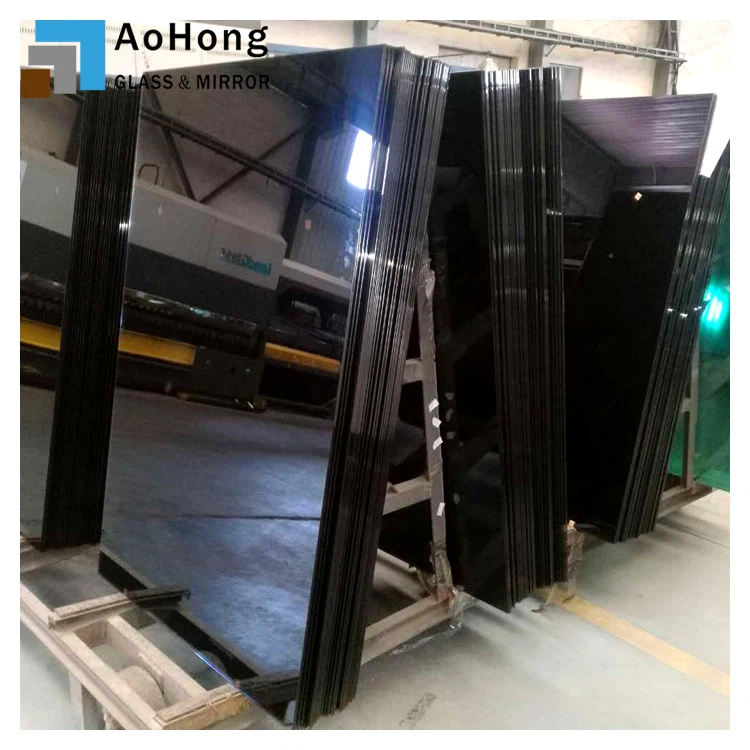

Bronze Colorants
The addition of bronze colorants to the glass can also have an impact on the refractive index. Bronze colorants are typically metal oxides or other compounds that are added during the glass - making process. These colorants can change the electronic structure of the glass, which in turn affects how light interacts with the material.
In general, the presence of metal ions in the glass can increase the refractive index slightly. The exact increase depends on the type and concentration of the bronze colorants. For Bronze Frosted Glass, the refractive index can range from about 1.52 to 1.55, depending on the specific formulation of the glass and the amount of colorants used.
Measuring the Refractive Index of Bronze Frosted Glass
Measuring the refractive index of Bronze Frosted Glass is more challenging compared to clear glass. Traditional methods for measuring refractive index, such as using a refractometer, rely on the ability to pass a well - defined beam of light through the material and measure the angle of refraction.
Due to the light - scattering nature of frosted glass, a more sophisticated approach may be required. One method is to use ellipsometry, which measures the change in the polarization state of light reflected from the surface of the glass. This technique can provide information about the optical properties of the glass, including the refractive index, even in the presence of surface roughness.
Another approach is to take a small sample of the non - frosted part of the glass (if available) and measure its refractive index using a standard refractometer. This value can then be used as an approximation for the bulk glass material in the Bronze Frosted Glass.
Importance of the Refractive Index in Applications
The refractive index of Bronze Frosted Glass is an important factor in various applications.
Architectural Applications
In architecture, Bronze Frosted Glass is often used for partitions, doors, and windows. The refractive index affects the way light is transmitted and scattered through the glass. A higher refractive index can result in more light being bent and scattered, which can create a softer, more diffused lighting effect inside a building. This can be desirable for creating a comfortable and aesthetically pleasing environment.
Decorative Applications
For decorative purposes, the refractive index can influence the appearance of the glass. The way light interacts with the glass can enhance the visual appeal of the bronze color and the frosted texture. It can also affect how the glass reflects and refracts surrounding objects, adding depth and interest to the overall design.
Optical Applications
Although Bronze Frosted Glass is not typically used in high - precision optical applications, the refractive index still plays a role. In some cases, such as in the design of lighting fixtures or display cases, the refractive index can affect the distribution of light and the visibility of the objects inside.
Why Choose Our Bronze Frosted Glass
As a supplier of Bronze Frosted Glass, we take pride in offering high - quality products with consistent optical properties. Our team of experts carefully controls the glass - making process, including the selection of base glass, the addition of bronze colorants, and the frosting process, to ensure that our Bronze Frosted Glass has a refractive index within the desired range.
We understand the importance of the refractive index in different applications, and we work closely with our customers to provide the best - suited glass for their projects. Whether you are an architect, a designer, or a manufacturer, our Bronze Frosted Glass can meet your specific requirements.
Contact Us for Procurement
If you are in the market for Bronze Frosted Glass and want to learn more about its refractive index and other properties, or if you have a specific project in mind, we encourage you to contact us. Our sales team is ready to assist you with any questions you may have and to discuss your procurement needs. We can provide samples, technical specifications, and pricing information to help you make an informed decision.
References
- Hecht, Eugene. "Optics." Addison - Wesley, 2002.
- Scholes, Colin A. "Glass Science and Technology." Royal Society of Chemistry, 2006.
- Zeng, Xiao Cheng, et al. "Optical Properties of Glasses." CRC Press, 2010.


